
When a study blows up there is a temptation to flatten it into one bullet point. What frustrates me about the latest headlines proclaiming that setting “does not hamper progress” is not simply the conclusion itself, but the astonishing narrowness of what is being measured to rationalise a system that stratifies children. A slight increase in attainment scores in one domain is being treated as justification for a system that carries profound academic, psychological and social consequences. One study measuring marginal differences in test outcomes in Years 7 and 8 does not negate the broader research on belonging, academic self-concept, curriculum access, peer identity formation, social mobility, and long-term educational trajectories. The EEF’s sensible recommendations do not match the headlines that call for setting.
The most important question to ask that arises after reading the new EEF study is this: How do we truly challenge high-attaining students in mixed-ability lessons? I have a book of ideas on that, drawing on the inspiring work of Mary Myatt, Tom Sherrington, Deborah Eyre, Alex Quigley, Jal Mettha and Sarah Fine. Education needs to be a force for overwhelming good, a mechanism for social transformation, not a maintenance system for social reproduction and immobility.
This is why the current enthusiasm for setting feels so regressive. At precisely the moment when educational research is deepening our understanding of adaptive teaching, inclusion, multilingualism, neurodiversity and culturally responsive pedagogy, we are returning to structures that sort children according to perceived ability and place them onto different curriculum pathways. Instead of asking how pedagogy and curriculum can become more responsive, ambitious and inclusive, we are asking how children can be more efficiently categorised. We need to think bigger.
Looking deeper, the research on ability grouping is not ambiguous about patterns of who is misallocated into sets and how we perpetuate cycles of inequity through ability structures:
- Grouping decisions are shaped not only by attainment, but by teacher perceptions of behaviour, language proficiency and “ability”, which are themselves influenced by implicit bias and structural inequity (Gillborn et al., 2016; Strand, 2014).
- Pupils from socio-economically disadvantaged backgrounds are significantly more likely to be placed in lower sets and streams, even when prior attainment is comparable to their peers (Hallam & Parsons, 2013; Francis et al., 2017).
- Multilingual learners, students with SEND, and pupils from underserved ethnic minority backgrounds are disproportionately represented in lower groups and tracks (Gillborn & Youdell, 2000; McGillicuddy & Devine, 2018).
- Summer-born pupils are more likely to be placed in lower groups during early schooling, illustrating how developmental maturity is routinely mistaken for fixed academic ability (Campbell, 2015).
- Once students are placed into lower sets, movement between groups is often limited, creating a “fixity” in educational pathways and expectations over time (Hallinan, 2003; Campbell, 2015).
- Lower sets are more likely to be taught by less experienced or non-specialist teachers, while the most experienced teachers are disproportionately allocated to top sets (Francis et al., 2017). There is cyclical inequality when schools allocate their best teachers to the top sets. The recent Guardian article notes this with Pepe Di’Iasio, the general secretary of the Association of School and College Leaders, quoted as saying “The essential ingredient is, of course, having sufficient numbers of specialist maths teachers to ensure that pupils at all attainment levels receive the best support possible. Unfortunately, there is a longstanding problem with recruiting maths teachers and many schools have no choice other than to use nonspecialists and supply cover.”
- Students in lower groups frequently experience narrowed curriculum pathways, repetitive tasks, reduced access to disciplinary thinking and fewer opportunities for conceptual discussion (Boaler & Wiliam, 2001; Oakes, 2005).
- Pupils placed in lower sets report lower academic self-concept, reduced confidence, and feelings of shame, inferiority and exclusion (Boaler et al., 2000; McGillicuddy & Devine, 2020).
Taken together, these findings reveal something deeply troubling. Setting does not simply organise learning. It stratifies opportunity and shapes academic identity for both teachers and students. Earlier this year I heard a student in a lesson say ‘I’m a bottom set dummy, I’m not going to be good at this.’ It broke my heart, that her intellectual identity was being determined by a baseline assessment setting her in Year 7 Maths. To call setting ‘old fashioned’ would be polite. To think that the deleterious effects of setting can be confined to one subject in the timetable is naive.
I love flexible grouping, let’s do this dynamically- the best maths and language lessons I’ve seen do this incredibly well. The latest EEF study notes that a change from past research, noting that some students felt more comfortable in lower set environments. Let’s dig into it- why? The study also notes that we need expert specialist teachers in bottom sets- again, let’s explore how schools with issues recruiting maths specialists can best deploy expertise. I understand the challenges, so let’s be ambitious in our pedagogical and organisational responses.
In an age where belonging in schools has become so important, there is a dissonance that is created when social polarisation is maintained through ‘ability’ structures. Studies about children’s emotional and psycho-social responses to ability grouping are difficult to read. Primary school students have described feelings of ‘shame’, ‘upset’ and ‘inferiority’ (McGuillicuddy and Devine, 2020, p 553). Ability grouping maps a geography of affect within the classroom, demarcating not only how children ‘do’ learning, but also how they embody learning through a particular feeling of ‘being’ a learner. Labelling children by ability is a deeply embodied and affective process, impacting directly on how children view and internalise their identities. Over time, the lesson fades, but the story a learner tells themselves about their identity remains.
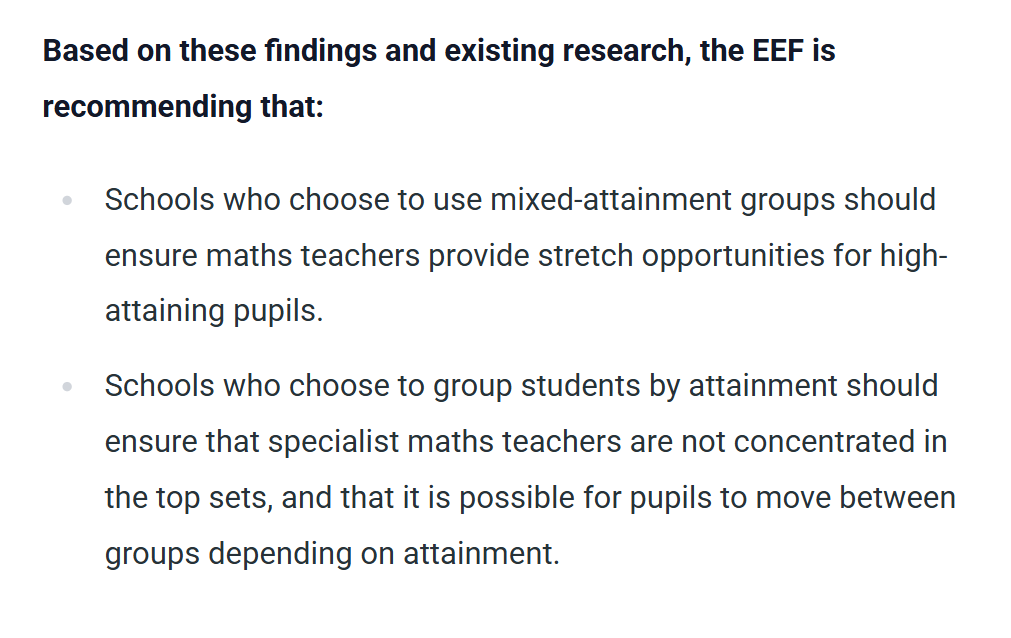
EEF Recommendations- April 29 2026- based on new research on student grouping in maths, conducted by the UCL Institute for Education
I would never describe a friend as ‘less able’ or a colleague as ‘low ability’. Yet this is the language, explicit and implied, that sits beneath many of our professional structures. Education that holds entrenched ability labels and the thinking behind it, has shaped how young people see themselves.
Setting has systematically given the students with the greatest complexity of need the least access to challenge, expertise and intellectual richness. It is the quiet symbolic violence of confusing learning differences, language acquisition or educational disadvantage with fixed limitations in human potential. We need to upgrade the system, and upskill our teachers with adaptive experitise, to uplift our students.
References
Boaler, J., Wiliam, D. and Brown, M. (2000) ‘Students’ experiences of ability grouping disaffection, polarisation and the construction of failure’, British Educational Research Journal, 26(5), pp. 631–648.
Boaler, J. and Wiliam, D. (2001) ‘Setting, streaming and mixed ability teaching’, in Dillon, J. and Maguire, M. (eds.) Becoming a Teacher: Issues in Secondary Education. Buckingham: Open University Press, pp. 173–181.
Campbell, T. (2015) ‘Understanding the impact of post-entry streaming on primary students’ self-concept, motivation and academic achievement’, British Educational Research Journal, 41(3), pp. 455–474.
Francis, B., Taylor, B. and Tereshchenko, A. (2017) Reassessing Ability Grouping: Improving Practice for Equity and Attainment. London: Routledge.
Gillborn, D. and Youdell, D. (2000) Rationing Education: Policy, Practice, Reform and Equity. Buckingham: Open University Press.
Gillborn, D., Rollock, N., Warmington, P. and Demack, S., 2016. Race, racism and education: Inequality, resilience and reform in policy & practice. Society for Educational Studies.
Hallam, S. and Parsons, S. (2013) ‘The incidence and make up of ability grouped sets in the UK primary school’, Research Papers in Education, 28(4), pp. 393–420.
Hallinan, M. T. (2003) ‘Ability grouping and student learning’, in Hallinan, M. T. (ed.) Handbook of the Sociology of Education. New York: Springer, pp. 95–108.
McGillicuddy, D. and Devine, D. (2018) ‘“You feel ashamed that you are not in the higher group”: Children’s psycho-social response to ability grouping in primary school’, Learning and Instruction, 37, pp. 104–112.
McGillicuddy, D. and Devine, D. (2020) ‘“Turned off” or “ready to fly”? Ability grouping as an act of symbolic violence in primary school’, British Journal of Sociology of Education, 41(4), pp. 549–565.
Oakes, J. (2005) Keeping Track: How Schools Structure Inequality. 2nd edn. New Haven, CT: Yale University Press.
Taylor, B., Francis, B., Tereshchenko, A., Mazenod, A., Campbell, T., Hill, M. and Haynes, G. (2025) Student Grouping Study: Evaluation report and executive summary. London: Education Endowment Foundation.
Strand, S. (2014) Ethnicity, Deprivation and Educational Achievement at Age 16 in England. Oxford: University of Oxford.
Image credit: https://www.the74million.org/article/americas-education-system-is-a-mess-and-its-students-who-are-paying-the-price/