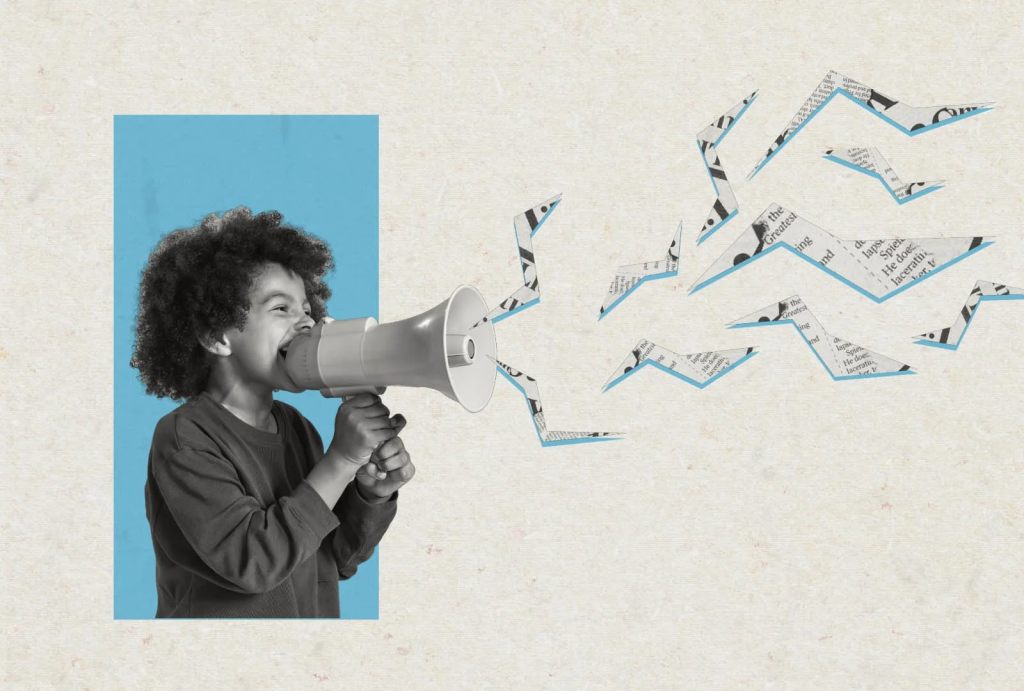
I fainted the first time I ever stood to speak in front of an audience. I was eleven years old, moments away from taking part in a local public speaking competition run by a community charity group. I remember the weight of the room, the polite hush, the hall lights pressing down on me, and the sudden rush of fear that travelled from my chest to my fingertips. The nerves were overwhelming. Everything narrowed, then disappeared. I fainted clean away.
What has stayed with me more than the embarrassment was what happened afterwards. Someone helped me up. I was given water, a moment to gather myself and the chance to decide whether I wanted to try again. And I did. My voice shook. My hands trembled. But I spoke, and in doing so I discovered something important. I realised I could stand, speak and be heard, even if fear travelled with me. That early lesson has shaped the educator I eventually became.
My journey was not linear. Throughout my teens I was the quiet one in class discussions, the student who thought deeply but rarely took the risk of speaking publicly. The place where all this changed was Model United Nations. In MUN I found a structure that held me. The roles, the rules of procedure, the framing devices and the expectation that every delegate had a responsibility to their committee lifted speaking from something personal and exposing to something purposeful. MUN taught me to research, to negotiate, to frame arguments logically and to respond with agility. It gave me the space to practise criticality and to speak with authenticity. And even now, as someone who presents regularly, I still get nervous. I have simply learned to work with the nerves rather than be overwhelmed by them. I found my voice through oracy. I found confidence, connection and critique.
This is why oracy matters. It is not an add-on. It is foundational to how students learn, think and participate in the world.
Why Oracy Matters: A Research-Informed Perspective
Creating space for student voice is powerful. Oracy scaffolds linguistic, cognitive and social skills. Medina (2020, p. 35) notes that learning diminishes when students are forced into passive roles. To engage learners actively, they must have regular opportunities to communicate verbally. When students speak, they transform information. They summarise, connect ideas, articulate meaning and make knowledge their own. Speaking is an act of cognitive structuring.
Classroom talk, when structured well, deepens understanding. Students can experiment with rhetorical techniques like metaphor, humour and irony to clarify and elaborate concepts. Formative assessment can be strengthened through oracy frameworks, giving teachers real-time insight into student thinking.
In the UK, the oracy education charity Voice 21 has repeatedly demonstrated the academic and social benefits of sustained oracy practice. Spoken language skills are among the strongest predictors of future life chances. Yet young people from low-income families have fewer opportunities to develop these skills. Oracy can help narrow that gap. According to Voice 21’s 2021–22 Impact Report, effective oracy education increases engagement, academic outcomes, confidence and wellbeing. It strengthens transitions between key stages and builds the communication skills essential to civic life.
Their research highlights three key findings:
- Oracy boosts attainment in reading
Students in Year 6 and Year 7 who participated in their Voicing Vocabulary programme showed accelerated progress, with 80 percent meeting or exceeding expected progress. One third exceeded expected progress entirely. - Oracy increases confidence and is especially crucial at transition points
Students’ anxiety about speaking in class increases significantly as they move from primary to secondary school. Explicit oracy instruction fosters academic, social and emotional confidence. - Oracy improves outcomes across subjects
English and the humanities lead the way, but STEM subjects increasingly recognise the value of disciplinary talk. Empowering students to “speak like specialists” inducts them into the ways of knowing and communicating unique to each subject.
Furthermore, cognitively challenging classroom talk in Year 5 has been found to produce gains equivalent to two months’ additional progress in English and science, and one month in mathematics (Cambridge Primary Review Trust and York University, 2017).
Oracy also enhances critical thinking. The English-Speaking Union (2023) points to four skillsets essential for rigorous talk: reasoning and evidence, listening and response, expression and delivery, and organisation and prioritisation. These skills underpin both academic success and the interpersonal competencies valued in contemporary, collaborative societies.
Debate-Centred Argumentation: A Vehicle for Deep Thinking
Debate is one of the most powerful vehicles for structured oracy. It teaches students to frame claims, weigh counterarguments, scrutinise evidence and respond thoughtfully. Debate-centred argumentation cultivates active reasoning rather than passive recall. It is a relational process; students must listen in order to argue well. They must adapt their thinking in real time.
When done well, debate does not favour the loudest voice but instead promotes equity. It invites multiple viewpoints and requires students to justify their positions with clarity and care. It strengthens self-regulation, empathy, criticality and collaboration.
High-Quality Oracy Activities for the Classroom
Below are practical strategies that support debate-centred argumentation and broaden access to oracy for all learners.
Resident experts
Students who demonstrate mastery in a particular area prepare a short demonstration, teach a concept or run a class activity such as a quiz or challenge. Their peers ask questions and probe ideas, promoting accountability and the articulation of disciplinary language. I often use resident experts in curriculum compacting, enabling students with advanced knowledge to extend their learning while supporting the class community.
Inner–Outer Circle discussions
Divide the class into two concentric circles. The inner circle discusses a prompt while the outer circle listens, taking structured notes divided into questions, insights and counterpoints. After a set time, the groups switch. This rotational dialogue promotes active listening, reduces dominance, and ensures that every student has an opportunity to speak. A non-repetition rule encourages students to contribute new thinking each round. Conclude by having both circles summarise key takeaways.
Interviews
Students interview one another or members of the wider community on a shared topic, then report their findings back to the class. This activity strengthens questioning techniques, deep listening and the ability to synthesise complex information. It creates a bridge between academic knowledge and lived experience.
Balloon debates
In a balloon debate, students adopt the roles of real or fictional figures and argue why they should be saved from a hypothetical crisis. Each participant presents a persuasive case, responding to others in real time. The audience votes, gradually narrowing the field. This light-hearted format builds persuasive technique, improvisation and rhetorical agility.
Presentations, storytelling and role-play
Class presentations can be transformed from repetitive recitations into rich opportunities for creativity. Encouraging students to vary format, structure and delivery helps them deepen their message. Storytelling, character role-play and thematic framing devices all elevate the quality of presentation while building confidence and expressive range.
Structured argument grids
Students outline claims, evidence, counterarguments and rebuttals in visual grids before speaking. This scaffolding supports learners who need processing time, enables deeper reasoning and increases the quality of spoken contributions.
Instant responses
Pose a question, give ten seconds of silent thinking, then select students at random to respond. This builds fluency and ensures wide participation without overwhelming anxious speakers.
Oracy as Identity, Agency and Empowerment
For many students, speaking publicly is entwined with identity. Some need opportunities to rehearse privately before speaking aloud. Some thrive in small groups before whole-class participation. Some require targeted scaffolds to navigate disciplinary vocabulary. For multilingual learners, oracy is a bridge between languages. For neurodivergent learners, structured talk provides predictability and a sense of safety.
Oracy is not simply about producing confident speakers. It is about cultivating thinkers. It is about agency. It is about enabling students to see themselves as contributors whose ideas deserve to be heard.
What My Journey Taught Me
My own journey, from fainting in a school hall to speaking at conferences and engaging in public scholarship, reminds me that oracy is not innate. It is learned. It requires practice, vulnerability, modelling and patient educators who believe in the transformative power of student voice.
I still get nervous when I speak. I still feel the familiar flutter of adrenaline before a presentation. But I have learned to understand it. To work with it. To trust the process. That confidence was built slowly, through structured opportunities to speak, critique, interrogate and connect. It was built through oracy. Our students deserve the same.
Oracy and debate-centred argumentation are not luxuries. They are gateways to equitable learning, deeper cognition and human connection. When we build classrooms rich in purposeful talk, we create environments where students not only learn how to argue well, but learn how to think well. They discover their voice. And in discovering their voice, they discover themselves.
References
Alexander, R. (2017). Towards Dialogic Teaching: Rethinking Classroom Talk. 5th ed. York: Dialogos UK.
Bruner, J. (1984). Vygotsky’s zone of proximal development: The hidden agenda. New York: Routledge.
Cambridge Primary Review Trust and University of York (2017). The influence of classroom talk on primary school children’s learning. Cambridge: CPRT/York University.
English-Speaking Union (2023). Oracy in Education: Frameworks and Resources. London: ESU.
Medina, J. (2020). Brain Rules for Learning: Updated and Expanded. Seattle: Pear Press.
Mercer, N. and Littleton, K. (2007). Dialogue and the Development of Children’s Thinking. London: Routledge.
Voice 21 (2022). Impact Report 2021–22: Oracy for All. London: Voice 21.Voice 21 (2022). Voicing Vocabulary Programme Evaluation Report. London: Voice 21.